Firstly check out: NHS England Assessment Activities: Evidence Tools and Requirements
So that you know what Supervised Learning Event (SLE) are needed for whch assessment activity.
For example 20. Medicines Optimisation can have the SLEs: Mini-CEX, CBD allowed. Whereas 24. History Taking can only have SLEs: Mini-CEX, DOPS are allowed.
You need to have a minimum of 3 separate/individual SLEs per assessment activity. And also 1 RA per activity.
!!! Important: Observed activities by others do not count as an SLE by itself.
So you have shadowed someone, and they conducted the consultation, and you just observed = you can't submit an SLE. This would be an RA.
During your placement, you will have the opportunity to complete all your assessment activities.
When you do 1 case, for the SLE, you can do 1 CBD, 1 DOPS, and 1 mini-CEX on that 1 case. However you can only tag non-overlapping assessment activities. i.e. you cannot for example tag both mini-CEX and DOPS as evidence for 24. History Taking from that case. You can choose only 1 to tag and evidence. But by writing up 1 case = 1 CBD, 1 DOPS, 1 mini-CEX you can hit multiple assessment activites (non-overlapping).
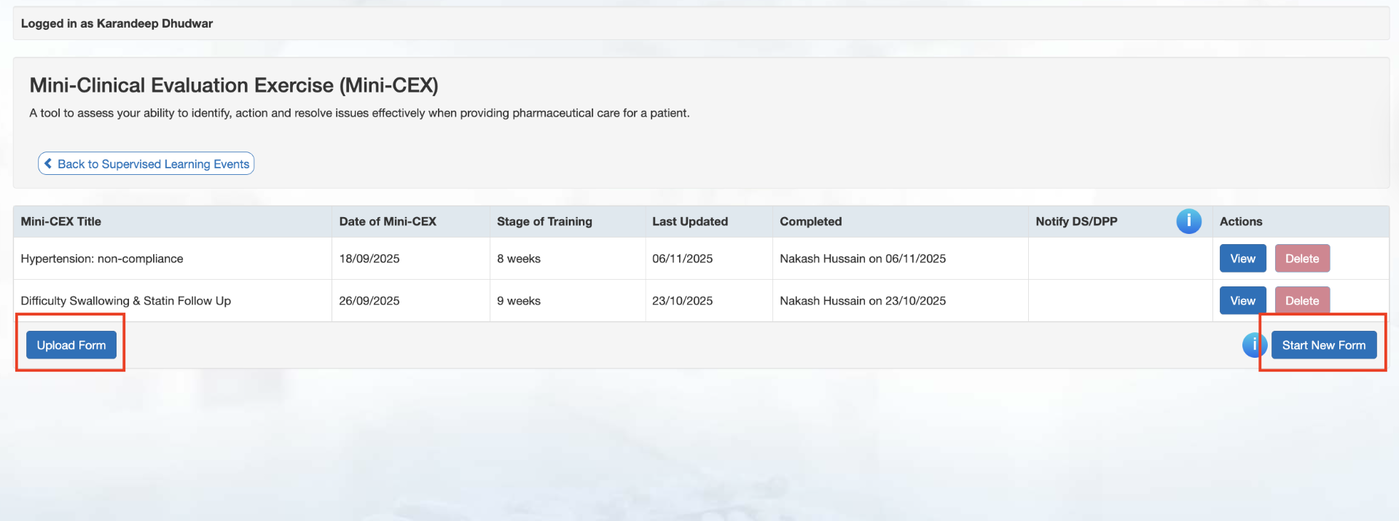
CLICK on START NEW FORM (right button).
Always Submit an SLE (otherwise DPP will not see it).
When DPP has marked your SLE - you need to manually inform DS to coutnersign.
Sample case:
Summary of case *
A 45-year-old male of Black African descent presented with persistently elevated blood pressure (152/96 mmHg) and had recently been initiated on ramipril. On review, I identified that this was not aligned with current hypertension guidelines, which recommend a calcium channel blocker as first-line therapy in patients of Black African or Caribbean family origin without diabetes or CKD. (LO29, LO30, LO31).
As part of medicines optimisation, I conducted a structured review of the patient’s antihypertensive therapy (LO8), assessing:
1. Indication and guideline concordance >> ramipril was not the most effective first-line choice for this demographic group (LO29)
2. Efficacy >> BP remained uncontrolled, suggesting suboptimal therapeutic response (aligns with low renin in this category of pts) (LO27)
3. Safety >> considered risks of ACE inhibitor-related adverse effects (e.g. cough, angioedema), which have a higher incidence in this population(LO5)
4. Adherence and patient understanding >> explored the patient’s experience with the medication and any concerns (LO3, LO10)
Based on this, I recommended switching to amlodipine 5mg once daily in line with NICE. I ensured the dose selected was appropriate for achieving BP control while balancing tolerability (LO30). I justified the dose using BNF recommendations (starting at 5 mg, titrating to 10 mg if required) and planned review at 2-4 weeks to assess response and tolerability (LO34).
I provided comprehensive counselling on (LO5, LO26, LO12):
Expected benefits (improved BP control, reduced cardiovascular risk)
Common side effects (peripheral oedema, headache, dizziness) and how to manage them
Adherence strategies and the importance of consistent daily dosing
Lifestyle modifications, including salt reduction, caffeine intake, weight management, and physical activity
To optimise patient centred care, I clearly explained the rationale for switching therapy, particularly addressing the patient’s question regarding differences in treatment compared to friends that were on ramipril. I would use shared decision making to involve the patient in the plan, ensuring they were informed and agreeable to the change.(LO2, LO3, LO10)
Plan (LO34)
Discontinue ramipril
Initiate amlodipine 5mg once daily
Arrange BP review in 2-4 weeks to assess response and tolerability
Monitor for side effects, particularly ankle swelling
Consider step up therapy if BP remains above target
What went well? *
I effectively applied guideline-based prescribing to identify and correct suboptimal therapy, demonstrating strong clinical reasoning in medicines optimisation. I took a holistic approach by considering efficacy, safety, and patient specific factors, rather than focusing solely on BP readings. My communication was clear and patient centred, particularly when explaining the rationale for treatment changes and addressing concerns about differences in care. I also incorporated lifestyle advice alongside pharmacological management, supporting a comprehensive approach to cardiovascular risk reduction.
Suggestions for development
Being a prescriber means being able to justify why you prescribed it and documenting appropriately, because i dont have much experience in this, im eager to improve in this. presenting my case to my peers helped me build on this. i also want to take the opportunity to learn how GPs document and justify to help build on my skills.
Agreed action *
SMART: Specific, Measurable, Achievable, Realistic and Timely
Specific: I will practise explaining and documenting my reasoning for initial drug choice, dose selection and step-up therapy in hypertension cases (and outside of HTN when shadowing)
Measurable: I will complete at least 3 supervised cases where I verbalise my plan and receive targeted feedback on clarity and clinical justification
Achievable: I will use NICE guidelines to support my decisions and compare my rationale with feedback from supervisors
Relevant: This will strengthen my medicines optimisation skills and ensure my prescribing decisions are clear, evidence-based and suitable
Time-bound: I will achieve this within the next 4 weeks
Trainee Pharmacist Reflection *
This case reinforced the importance of applying guideline based, patient specific prescribing to optimise treatment. I correctly identified that the initial therapy was not appropriate and adjusted it to improve efficacy and safety, while maintaining a patient centred approach through clear communication and shared decisionmaking.
However, it highlighted that I need to improve how I verbalise and document my clinical reasoning, particularly around dose selection and escalation. Developing this will ensure my decisions are clear and can be effectively communicated within the multidisciplinary team (especially important skill to have if in a different setting like hospital where you do hand overs)