Submit a Reflective Account (RA) daily after each day’s worth of shadowing.
I have included a gold standard reflection alongside the SMART action plan.
Name it by day of your shadowing i.e.:
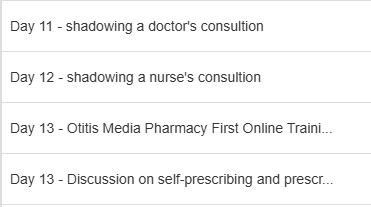
Reflections
Briefly outline your area of work (the setting of your practice and your main roles).
Explain the situation/activity you are undertaking and give examples of your activity in detail.
Note what you have learnt and what you would do differently, and link to the learning outcomes being evidenced.
The first patient presented with psoriasis on the lower back. I learned that some topical products, such as Anusol, can worsen psoriasis due to irritation or unsuitable ingredients. We discussed appropriate OTC options, such as emollients and mild topical corticosteroids, which help reduce inflammation and maintain skin hydration. This highlighted the importance of selecting suitable treatments based on the condition and avoiding exacerbating factors (LO21). It also reinforced assessing individual patient factors before recommending treatment (LO8).
The second patient had a discoloured toenail that was detaching, consistent with a fungal nail infection. She had already tried OTC treatments, including amorolfine, without success. A nail sample was taken for confirmation, and oral terbinafine was considered. I learned the importance of checking liver function tests (LFTs) before starting terbinafine and monitoring them periodically (after 4–6 weeks), discontinuing treatment if abnormalities occur. This demonstrated applying clinical knowledge to ensure safe prescribing (LO21, LO18) and recognising the physiological impact of medicines (LO13).
The third patient presented with scalp concerns, including a wart-like lesion. Although there were no immediate red flags (no growth or change over two years), due to the patient’s age and presentation, she was referred to dermatology. This emphasised working within clinical limits and referring appropriately (LO17), as well as taking a cautious, all-inclusive approach to patient care (LO12).
The fourth patient was a 9-year-old girl presenting with symptoms suggestive of possible anaemia (pallor, fatigue, feeling cold, recurrent mouth ulcers). Dr Fowler demonstrated excellent rapport-building by engaging the child in a friendly and reassuring way. Blood tests were arranged, and a topical anaesthetic gel (containing lidocaine) was prescribed to reduce pain during blood sampling. I initially confused this with amiloride, but clarified that lidocaine works by blocking sodium channels and preventing nerve conduction. This was a valuable learning point in applying pharmacological knowledge (LO21) and recognising the psychological impact of procedures, especially in children (LO13). It also highlighted the importance of communication and adapting style to the patient’s needs (LO3, LO4).
We also reviewed a patient with PTSD who was on sertraline and clonazepam. This consultation reinforced the importance of continuity of care and holistic management of mental health conditions, including medication review and monitoring (LO14), while maintaining empathy and patient-centred care (LO1).
Another patient presented with recurrent chest pain radiating to the arm and back, associated with breathlessness and pallor. Although previously diagnosed as musculoskeletal pain, Dr Fowler carefully reassessed the patient. I observed how to measure blood pressure manually and listened to Korotkoff sounds:
The first sound was the systolic pressure
The disappearance of sound indicated the diastolic pressure
This patient was prescribed a GTN spray for symptomatic relief and referred to cardiology for further investigations (ECG and chest X-ray). This demonstrated clinical reasoning, risk management, and appropriate referral (LO48, LO17), as well as recognising potential serious underlying conditions despite previous diagnoses (LO8).
The final patient presented with a unilateral tremor and wrist swelling. The tremor was not a classic resting tremor, making Parkinson’s disease less likely. Given the new onset and associated symptoms, the patient was referred to neurology. This reinforced recognising red flags and acting within professional limits (LO17), ensuring patient safety through appropriate escalation (LO18).
Overall Learning
This placement significantly developed my consultation and clinical reasoning skills. I observed how Dr Fowler adapted communication styles depending on the patient, demonstrating empathy, respect, and professionalism throughout (LO1, LO3, LO6, LO15). I also saw the importance of shared decision-making and involving patients in their care (LO2, LO10).
I learned to consider both clinical and psychological aspects when making decisions, ensuring a holistic approach to care (LO11, LO13). Working within a multidisciplinary environment and referring appropriately highlighted the importance of teamwork and continuity of care (LO14, LO46).
This experience also reinforced the importance of applying scientific knowledge in practice, particularly pharmacology and monitoring requirements (LO21, LO22), while recognising my own learning needs and areas for improvement (LO53). Moving forward, I aim to continue building my confidence in consultations and deepen my clinical knowledge to support safe and effective prescribing.
Agreed action *
S: Improve my knowledge of OTC treatments for common conditions and develop my ability to tailor language to suit individual patients when explaining treatment and medication use, while preparing for the GPhC exam.
M: Review 2–3 OTC conditions weekly using BNF/NICE and GPhC resources, and seek feedback on at least two patient interactions to assess communication effectiveness.
A: Achieve this through structured revision for the GPhC exam, self-study, observing clinicians, and applying skills during consultations.
R: Supports both exam success and safe, effective, person-centred care by improving patient understanding, adherence, and outcomes.
T: Over the next 9 weeks leading up to the GPhC exam, with weekly self-review of progress.